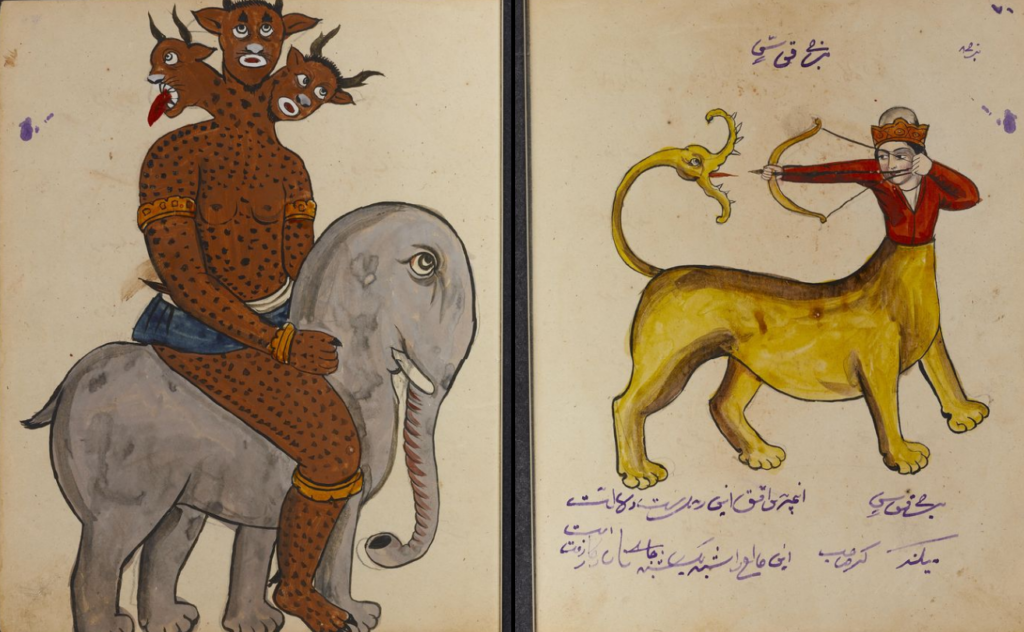
The manuscript is held by the Princeton University Library, Islamic Manuscripts, Third Series, no. 349. It is an illustrated Persian codex devoted to magic, astrology, incantations, talismans, and demonic and angelic figures. The title Kitāb-i ʿAjāʾib-i Makhlūqāt may be translated as Book of the Wonders of Creatures and should not be confused with the celebrated medieval cosmography by Zakariyyā al-Qazwīnī.
It is a composite manuscript. A note on the opening folio records that part of the codex was copied in Isfahan during the month of Shaʿbān in the year 1324 AH, corresponding to September–October 1906, by ʿAlī Muḥammad ibn Jaʿfar Abū al-Ḥasan al-Nāʾinī, or by a scribe whose name is very close to this. The library catalogue, however, dates the manuscript as a whole to 1921, suggesting a process of material and textual stratification.
CONTENTS OF THE CODEX
The codex contains a book of formulae, incantations, and talismans, together with fifty-six painted illustrations. The images, highly evocative in character, depict demons, zodiacal creatures, hybrid beings, and angelic figures. It is a text concerned with demonology, protective magic, and ritual astrology.
Ali Karjoo-Ravary, a historian of Islam and scholar of Persian culture, sources, and the visual history of the Islamic world, has proposed an important interpretation of the manuscript. According to him, the images were added to an earlier text, compiled roughly one or two decades before and devoted to talismans and formulae. The illustrated section would instead constitute a divinatory treatise in which various entities are associated with the signs of the zodiac and accompanied by ritual prescriptions intended to counteract their effects.
The attribution of an author or compiler remains problematic. The name of the copyist recorded in the opening note does not necessarily coincide with the author of the magical or illustrated sections. Karjoo-Ravary identifies a signature that may be attributed to “Rammālbāshī, son of Jaʿfar.” Rammālbāshī, however, does not appear to be a personal name, but rather a professional title. It derives from rammāl, a practitioner associated with raml, or geomancy, and more broadly with divinatory practices.
Within Iranian culture, a rammāl could be consulted for divination, the removal of harmful spells, ritual healing, exorcisms, talismans, and the summoning of spirits. The compiler of the manual attributes his knowledge to the Solomonic tradition, presenting Solomon as a wise ruler capable of controlling spirits, demons, and jinn. The manuscript therefore belongs to the wider Islamic and Persian tradition that attributes to Sulaymān, the biblical and Qurʾānic Solomon, a particular authority over invisible beings.
In Islamic magical literature, the possibility of subjugating jinn and demons receives a form of legitimacy through the prophetic figure of Solomon. The term jinn denotes a broad category of invisible beings within Islamic tradition; Persian and Arabic terminology may also include div, shayṭān, ifrīt, spirits, demons, and other entities with distinct characteristics.
The relationship with the title ʿAjāʾib al-Makhlūqāt requires one final caution. The best-known work bearing this title is the cosmography of al-Qazwīnī, a thirteenth-century author, devoted to the wonders of the cosmos, the heavens, planets, Earth, animals, peoples, and natural phenomena. The Princeton manuscript employs a title belonging to this tradition of the “wonders of creation,” but its content is very different: it is a practical dossier of magic, astrology, rituals, and demonology.
One page of the digitised manuscript contains later English annotations, apparently attempting to translate the text. I reproduce them below according to what it has been possible to reconstruct through an examination of the specific page.

The text contains a love formula in Persian and Arabic, accompanied by two talismans. According to the annotations appearing in the digitised copy, this is most likely its content.
Instructions for Those Who Desire to Be Loved
“In the name of God, the Most Compassionate, the Most Merciful. O God, Lord of the heavens and the earth, restore love; place the love of [name of the person] in the heart of [name of the other person].”
Take a handful of dust from the place over which the beloved man or woman has passed; recite this prayer three times and blow upon the dust while pronouncing it. This prayer is also effective between husband and wife if it is placed beneath their heads, presumably under the pillow.
A first talisman then follows, accompanied by the instruction:
“Talisman to be tied to the arm.”

A second prescription then follows, together with a second talisman:
“If you wish someone to become your lover, write this talisman and place it beneath hot charcoal ashes. Then that person will find no peace, not even for a single hour.”

The manuscript then presents twelve images depicting twelve demons, or entities, associated with the twelve signs of the zodiac.


Sources Consulted
Princeton University Library, Department of Rare Books and Special Collections. Kitāb-i ʿAjāʾib-i makhlūqāt. Islamic Manuscripts, Third Series, no. 349. Digital Princeton University Library, object pc289j126.
Karjoo-Ravary, Ali. “Demons Licking Your Toes: An Early 20th Century Manuscript from Isfahan.” Ajam Media Collective, 31 October 2017.




Leave a Reply