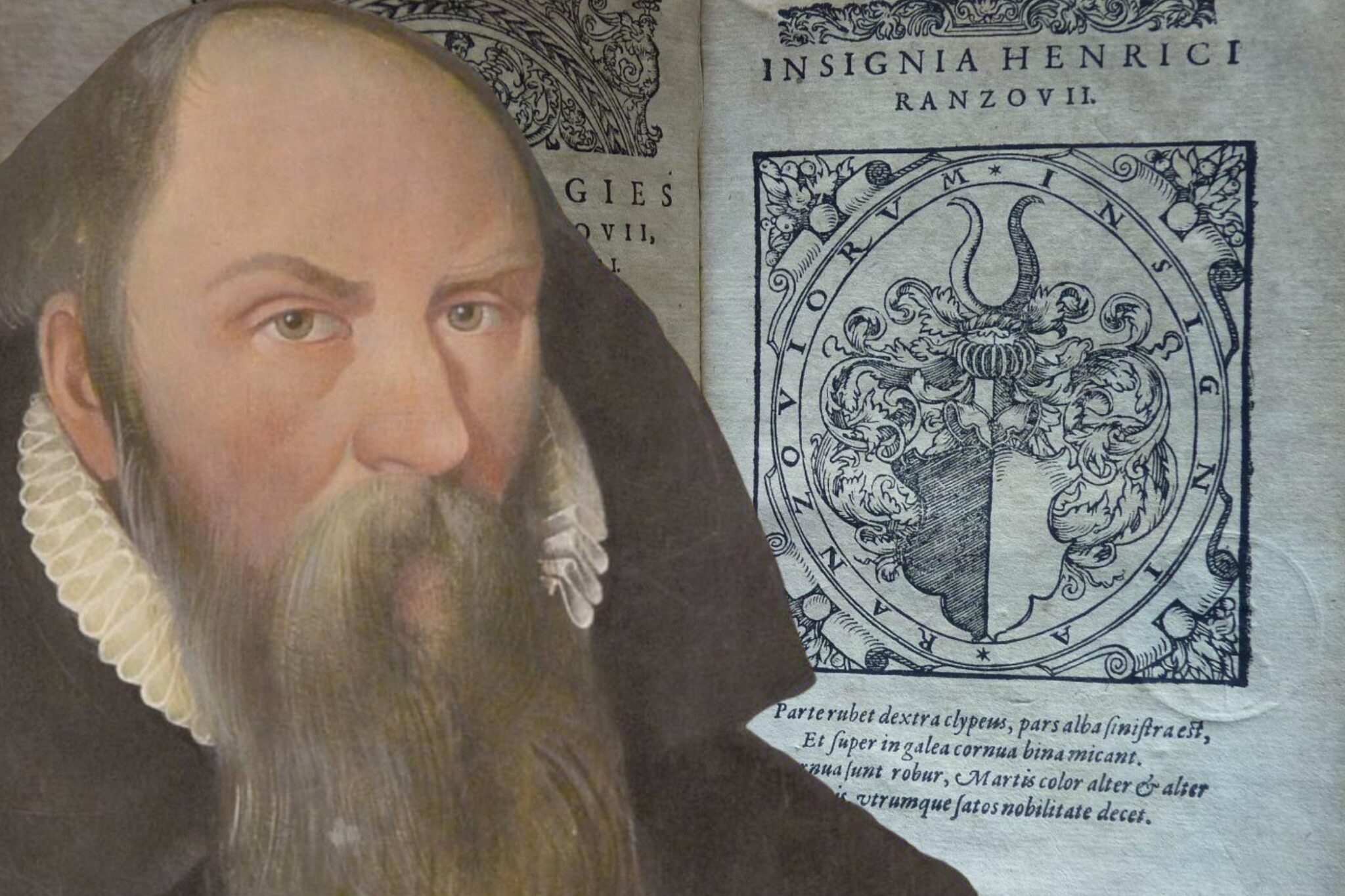
Henrik Rantzau, known in his Latin works as Henricus Ranzovius, lived from 1526 to 1598. He was a Holstein nobleman in the service of the Danish monarchy, a statesman, humanist, patron, and author of historical, geographical, and astrological writings. The son of Johann Rantzau, the renowned military commander of the Danish civil war of 1536, he instead received a distinctly humanist education. He studied for several years in Wittenberg, where he was especially influenced by the teaching of Philip Melanchthon, and later spent time at the court of Charles V. From 1556 until shortly before his death, he held the office of Statthalter, that is, royal representative and governor in the duchies of Schleswig and Holstein, serving under Christian III, Frederick II, and Christian IV. His intellectual activity was inseparable from his political standing and landed wealth. He possessed a substantial library, supported writers, printers, and scholars, financed historical and geographical works, and built a network of correspondence that reached many centres of northern European culture. His interest in astrology should therefore be placed within the framework of Renaissance humanism: not as an isolated pursuit, but as part of a broader inquiry into the relations between celestial order, history, nature, and political life.
In the eleventh chapter of the third part of Henrik Rantzau’s Tractatus Astrologicus De Genethliacorum Thematum Iudiciis pro Singulis Nati Accidentibus, the author offers a brief discussion of the dignity and honours of the native through the study of the natal chart. Rantzau, or Ranzovius (1526–1598), was a German astrologer, humanist, and general. He introduces the subject by immediately citing Ptolemy, who stresses the indispensable role of the luminaries. The Moon and the Sun surpass all other stars and lights of heaven in splendour and beauty, that is, in luminosity. In this way, the luminaries, the Sun and the Moon, arouse noble spirits, those who strive for important things, and those who powerfully resist every difficulty. They shine more brightly than anything else, as though they were contending against every other possible light.

The author writes that “the most powerful become such” when the luminaries occupy certain positions and possess certain qualities. He then proposes a series of indications, which are summarised below.
[1] The Sun prefers the signs of the fiery triplicity and, more generally, masculine signs. What Ranzovius wishes to convey is that we must judge the essential condition of the two luminaries, beginning with the nature of the sign and with the study of those qualities connected with the celestial sphere that relate to essential dignities. He adds that it is necessary to evaluate the essential dignities occupied by the luminaries. According to the author, the Sun prefers masculine signs, especially those of the fiery triplicity. This is because the Sun is hot and dry, while the signs of fire—Aries, Leo, and Sagittarius—are likewise hot and dry, and are therefore more harmonious with the Sun’s nature. Within the fiery triplicity, Aries is the sign of the Sun’s exaltation and Leo the sign of its domicile. Ranzovius states that the Sun’s essential dignity must also be judged. The more the Sun occupies dignified positions—domicile, exaltation, triplicity, term, or face—the more it signifies honour and distinction for the native. Conversely, more debilitated conditions—for example, fall, exile, peregrination, or placement in signs contrary to its essential nature—will suggest less honour, or a diminished capacity to be seen, appreciated, and recognised. In judgment, it is necessary to weigh several variables, sometimes very different from one another.
[2] For the Moon, feminine signs are generally to be preferred. Certainly, a waxing Moon signifies an increase in honour; more generally, however, a visible Moon is preferable in questions concerning honour, reputation, and fame. In this case too, as with the Sun, the conditions of essential dignity should be evaluated.
[3] It is also important to distinguish the luminary of the sect. Greater value must be given to the Sun in diurnal nativities and to the Moon in nocturnal nativities.
[4] The author also indicates that the position in the houses is important. We must distinguish between cadent and succedent houses that are inconjunct to the Ascendant—the sixth and twelfth houses, as well as the second and eighth—which are places of idleness and adversity, and which make the emergence of honour more difficult. Cadent and succedent houses that communicate with the Ascendant—the ninth and third, as well as the eleventh and fifth—are active places. They confer a certain nobility, fame, prestige, and honour, especially when the Sun occupies the ninth house, which is its joy, and the Moon the third house, which is hers. There are then the places of power and dominion: the first, tenth, seventh, and fourth houses, that is, the angles or pivots of the chart. Here the luminaries take on a role of authority, power, and the need to rule. Whether for good or ill, luminaries placed here, especially in the first and tenth houses, are greatly accentuated. Positively, they may signify the charisma of a king or of one who knows how to command; negatively, they may indicate the charisma of a despot or tyrant, or someone with territorial and sectarian ambitions.
[5] He then says that royal stars should be evaluated, especially when configured to the luminaries. Royal stars, but also the brightest stars when joined to the luminaries, accentuate a sense of radiance, splendour, nobility, and royalty.
[6] Then emerges the usual rule, which I have found in all medieval treatises: the relationship with the benefic planets. The Sun and Moon, when configured with benefics, are improved in their conditions. If their starting conditions are already good, these are further emphasised. In particular, relationships with Jupiter signify honour and the capacity to govern. Relationships with Venus signify beauty, and therefore persuasive and seductive ability.
[7] It is interesting to note that the author says Mars should not be underestimated. Although malefic, when it has certain relationships with the luminaries, especially with the Sun, and when Mars is in favourable essential condition, it may signify ability and authority. It is not uncommon, in fact, to find commanders and conquerors with a favourable configuration between the Sun and Jupiter, together with the intervention or support of a well-disposed Mars. For example, Dorotheus says of Mars in trine to the Sun: “In a nocturnal nativity, if Mars is lord of the hour and in trine aspect to the Sun, it indicates very great benefits and sometimes a powerful king. If Jupiter is in its own triplicity or in an angle, the native will be a noble and powerful leader; and if he is aspected by the Moon, he will be brave, master of life and death, quick to change residence, suspicious and distrustful even of himself, especially if he is in a masculine sign.”
THE CONDITION OF THE PLANETS
One passage to consider is the fact that the various planets judged in matters of honour must also be observed according to certain astronomical qualities. For example, visible planets (with regard to the five wandering planets, namely Mercury, Venus, Mars, Jupiter, and Saturn) signify the “visibility of the native”: his capacity to be seen, appreciated, popular, and famous. It follows that invisible planets diminish the effectiveness of popularity and fame, although they may still confer qualities of honour in private settings or within more restricted contexts. The speed of the planets is significant for the capacity to act and to operate effectively. Slowness, as well as retrograde planets, may indicate ambiguity: a way of appearing that conceals something, or appearing differently from what one truly is.
Latitude also has importance. Positive latitude, especially, may indicate the capacity to rise above others or to arouse an impression of notoriety, fame, and popularity. These considerations apply particularly to the Moon—except for retrograde or stationary motion, to which it is not subject—and to all those planets that rule the luminaries, govern them, or signify the native’s actions and works.
There is also an interesting passage concerning conjunctions. The author says that the strongest configuration, or the one that most clearly indicates authority and honour, is the conjunction, which should not properly be described as an “aspect.”
An aspect is a relationship involving a certain distance between two points—the sextile, trine, square, and opposition—whereas a conjunction is rather an apparent physical union, in which two bodies, or two natures, come together “for a single purpose” or to provide a unified nature in service of the native. Thus, in the natal charts of dictators and tyrants, as well as kings and queens, we often encounter strong conjunctions together with the angular position of the luminaries.
The five wandering planets (Mercury, Venus, Mars, Jupiter, and Saturn) may play an important role in determining honours, especially when they are placed in the tenth celestial house or in a celestial house that communicates with the tenth, namely the sixth, twelfth, second, or eighth house. In particular, according to Ptolemaic doctrine, Mercury, Venus, and Mars have a central role in defining one’s works and therefore also affect honour and reputation. These three planets are regarded as the natural significators of works. They contribute to the judgement of honours when they are related to the luminaries or to the celestial places that communicate with the tenth house, or when they are themselves placed in the tenth house. Significant heliacal phases within a nativity may also make them eligible to signify the native’s works. There are also important configurations between the Sun and the other planets, and between the Moon and the other planets. This figure is called Doriphory: it is a particular relationship which one celestial body—the doriphoros, or “spear-bearer”—forms in relation to another, generally the Sun or the Moon, when a number of conditions of strength are fulfilled. These involve the principal foundations of astrological theory: dignity, phase, motion, aspect, place, and hairesis. From the planet that performs the Doriphory and from the luminary that receives it, judgements are drawn chiefly concerning the parents, fortune, honours, and the native’s success. There are many forms of Doriphory, but the most effective are those in which the superior planets behold a luminary by trine, are in the appropriate phase—eastern of the Sun or western of the Moon—occupy strong places, conform to the hairesis of the luminary, and have rulership over its place. An example would be a daytime nativity in which the Sun is in Cancer and is beheld by Jupiter in Pisces, above the horizon and in a strong place.
The luminaries in the signs belonging to the luminaries themselves signify, or intensify, the indications of honour. Ranzovius adds, however, that if the luminaries, the Sun and Moon, are not angular, we must nevertheless evaluate the position of the fixed stars, especially on the Ascendant and Midheaven. Such stars can signify illustrious matters and fame, and may in some sense take the place of the luminaries.
But if the luminaries are in extreme conditions—without essential dignity, in weak places, and not configured to benefic planets—they indicate difficulty in attaining honour and fame, or even a tendency towards privacy and isolation.
If, on the other hand, mixed conditions are present, some good and some bad, then honour or fame may exist only among a small circle of close associates. Alternatively, honour may be exercised in a dominant and imperious, even stifling, manner.
Ranzovius therefore seems to distinguish between public and private fame, high, medium, and low renown, while also emphasising concepts such as unsociability, isolation, and reserve, in connection with the study of the essential and accidental strength of the luminaries.
Ranzovius comments on certain indications from Ptolemy, writing that if Saturn is with the Sun, if Saturn is oriental, if Saturn is in its dignities, and if it has dominion over the luminous places—meaning the places occupied by the luminaries, or if it has essential dominion over the Sun and Moon, as well as over the celestial places occupied by the luminaries or by their conjunctions—then it adds honour, riches, money, authority, or prestige.
The same applies to Jupiter, which confers greatness, favours, fortune, and elegance. The same applies to Mars, which is more inclined to grant command, the capacity for dominion, and conquest. The same applies to Mercury, which confers an authority more closely connected with knowledge and the study of things.
PARTEM HONORIS
Further indications reported by Ranzovius help in identifying important figures. For example, he states that Jupiter–Saturn conjunctions indicate the birth of great and famous persons, or of people who will bring important changes to society, politics, and public affairs. Consequently, Mars–Jupiter conjunctions also have a certain effect upon honour, as well as upon the capacity for dominion. Yet the previous rules still apply. Many people may be born with Jupiter and Saturn in conjunction, or with Mars and Jupiter in conjunction, but only some of them will become famous or bring change and benefit to all. This must be determined by judging the quality and strength of the luminaries. It is therefore the whole set of variables, and the convergence of several testimonies, that indicates a particular outcome.
Ranzovius then speaks of certain Lots, which he calls Partem Honoris. He may refer first to the Lot of Fortune, but also to more specific Lots, such as the Lot of the King and Sultan, the Lot of the Sultan’s Conquests and Victories, the Lot of Persons of High Rank, the Lot of the Native’s Activities, the Lot of Power, or the Lot of Success.
He also identifies certain degrees of exaltation: the 19th degree of Aries, which is the exaltation of the Sun, and the 3rd degree of Taurus, which is the exaltation of the Moon. Ranzovius appears to regard these as degrees in which the presence of the luminaries, other planets, or Lots may signify something concerning honour and fame. He then cites several authors. Some of them consider the Midheaven, the planets in the tenth house, and the qualities of the ruler of the tenth house. These will have significance for honour, power, and dominion. Other authors, he says, prefer the Ascendant and the planets present there. Such planets may confer great power upon the native. Planets in the first house, whether benefic or malefic, become an integral part of the body, soul, temperament, and mind of the native, because the Ascendant signifies the whole body and therefore all its psychic and rational functions, within the native’s temperamental constitution.
Ranzovius makes a very interesting observation: Jupiter also participates in the significations of honour. For example, Jupiter in the tenth house, or on the Ascendant, may indicate honour and royalty. Yet he says that this cannot by itself signify public honorary offices or public recognition.
What he means is that Jupiter in the tenth or first house, even when strongly placed, is not sufficient by itself. We must always refer to the condition of the luminaries. Jupiter in the tenth house may confer honour and worth, but these may be experienced privately, or within extremely restricted circles.
When that honour and worth become public, recognised by everyone, we will most likely find a condition of strength in the luminaries: dignified both essentially and accidentally, and configured in some way with Jupiter. In this way, the fame promised by a dominant Jupiter becomes public fame.
He then adds the following statements:
The native will frequent influential circles of society, or places that confer power, fame, and royalty, when Jupiter and Saturn are in their own domiciles. Saturn on the Ascendant and in its own domicile, with Jupiter aspecting Saturn, signifies the same thing.
Venus in aspect to Jupiter, especially by trine, and Venus in the tenth house, signify royal manners, love, and passions. In such a case, that which rules and brings honour is attitude, love or passion for things, creativity, charisma, and magnetic, alluring beauty.
Ranzovius concludes the chapter by stating that the Moon plays a fundamental role in both diurnal and nocturnal nativities, because it signifies popularity and the increase of wealth.
Sources Consulted
Ranzovius, Henricus. Tractatus astrologicus, de genethliacorum thematum iudiciis pro singulis nati accidentibus. Rosa, 1615.





Leave a Reply